Why AQS builds its own sanitary conveyors, what the purchased ones taught us, and what that means for a plant deciding whether to let a new conveyor vendor onto the floor.
Executive Summary
When a plant engineer sees an AQS conveyor layout for the first time, the first question is usually not about the conveyor. It is about AQS. Why haven't I heard of you? Why should I bring in a new vendor when I already have one under a master agreement?
Both are fair questions, and this paper answers them plainly. AQS is new to selling conveyors. It is not new to building them. For years AQS built sanitary conveyance only inside its own robotic systems, because the conveyors it bought from established 24 VDC and sanitary conveyor manufacturers were never quite right for sanitary washdown and tight product control. The conveyors AQS sells today exist because the purchased ones failed, and they are designed by people who have been putting conveyance into food plants for well over a decade.
- ▸AQS conveyance ran inside AQS robotic cells for years before it was sold on its own
- ▸The design decisions that define it, continuous TIG-welded frames, water-shedding geometry, application-matched belting, and open Allen-Bradley controls, are each a direct answer to something a purchased conveyor got wrong
- ▸AQS began selling conveyor systems standalone at the beginning of 2025, when a gap opened in the market for high-control sanitary conveyance
- ▸Layouts and quotes turn around in the customer's timeframe because the engineering is done by the people who build the system
- ▸A vendor agreement is a procurement step, not an engineering one; AQS runs it in parallel with layouts rather than ahead of them
The Question Behind the Question
A conveyor is the most ordinary thing on a packaging line. It is also the thing that gets touched by sanitation every night, carries every package the plant makes, and sits between every piece of equipment that cost real money. A plant that has settled on a conveyor vendor has usually done so for defensible reasons: the vendor is known, the paperwork is done, and the last system worked well enough.
So when a layout arrives from a company the buyer does not recognize, the question underneath "why AQS" is really "what do you know that my current vendor doesn't, and how would I know?" This paper is the answer AQS gives to that question, in enough detail to be checked.
What We Were Building Before
AQS has been building automation for food and beverage plants since before it sold a single conveyor. The core of the business was robotic systems: palletizing, case handling, and sanitary pick-and-place cells for dairy, protein, and frozen food, in washdown environments where the robots themselves had to be rated for caustic cleaning. Every one of those systems included conveyance. Product had to arrive at the robot presented consistently, cases had to accumulate without crushing, pallets had to move away clean.
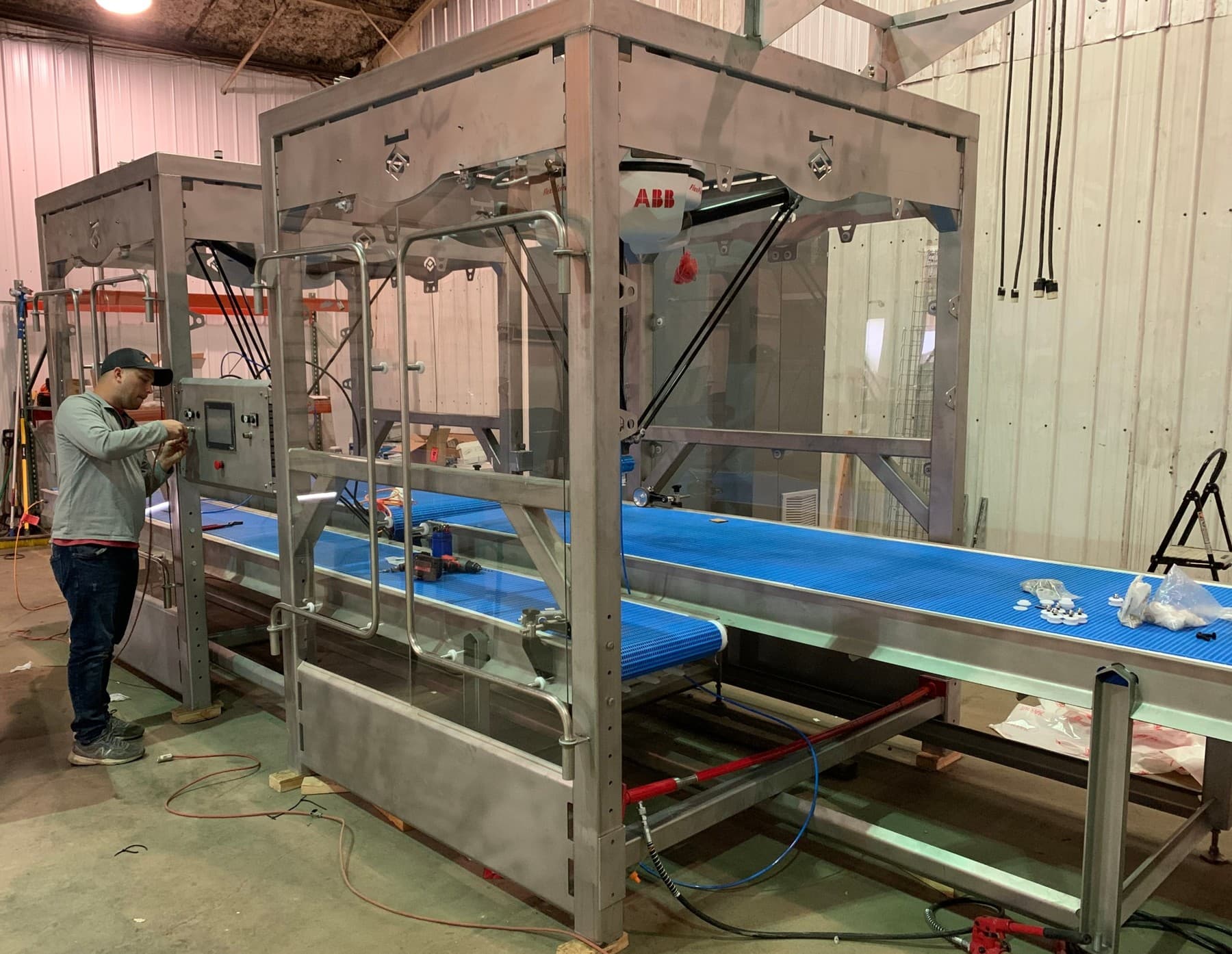
In the early years, AQS did what most integrators do. It bought the conveyors. Motorized-roller sections from the established 24 VDC vendors for case and pallet handling, belt conveyors from the established sanitary conveyor manufacturers for product transport. These were good products from good companies, and for a dry warehouse they would have been the end of the story.
They were not the end of the story in a dairy.
What the Purchased Conveyors Taught Us
The problems were never dramatic. A conveyor rarely fails outright. It falls short in ways the sanitation crew and the maintenance tech notice long before the buyer does, and each of those ways became a design rule once AQS started building its own.
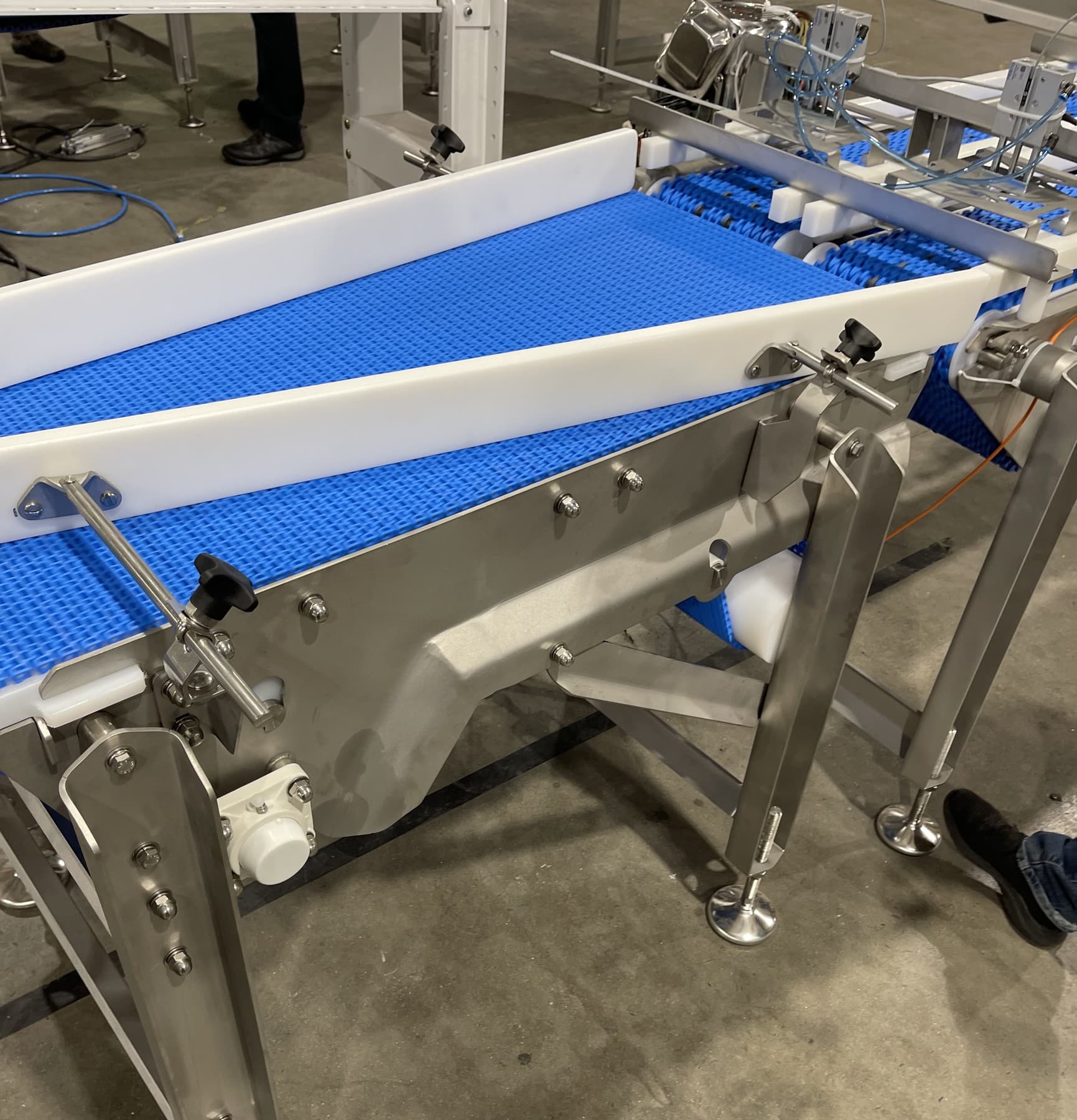
Bolted frames held water. Catalog frames are bolted together because bolts are cheap to ship and easy to assemble on site. Every bolted joint is a crevice, and every crevice holds the residue that washdown is supposed to remove. AQS conveyors are continuous TIG-welded, frame to cross member to leg, because a joint that does not exist cannot harbor anything. The same logic drove the mirror finish and the sloped and curved frame geometry: a surface that sheds water in seconds does not need a second pass with a hose.
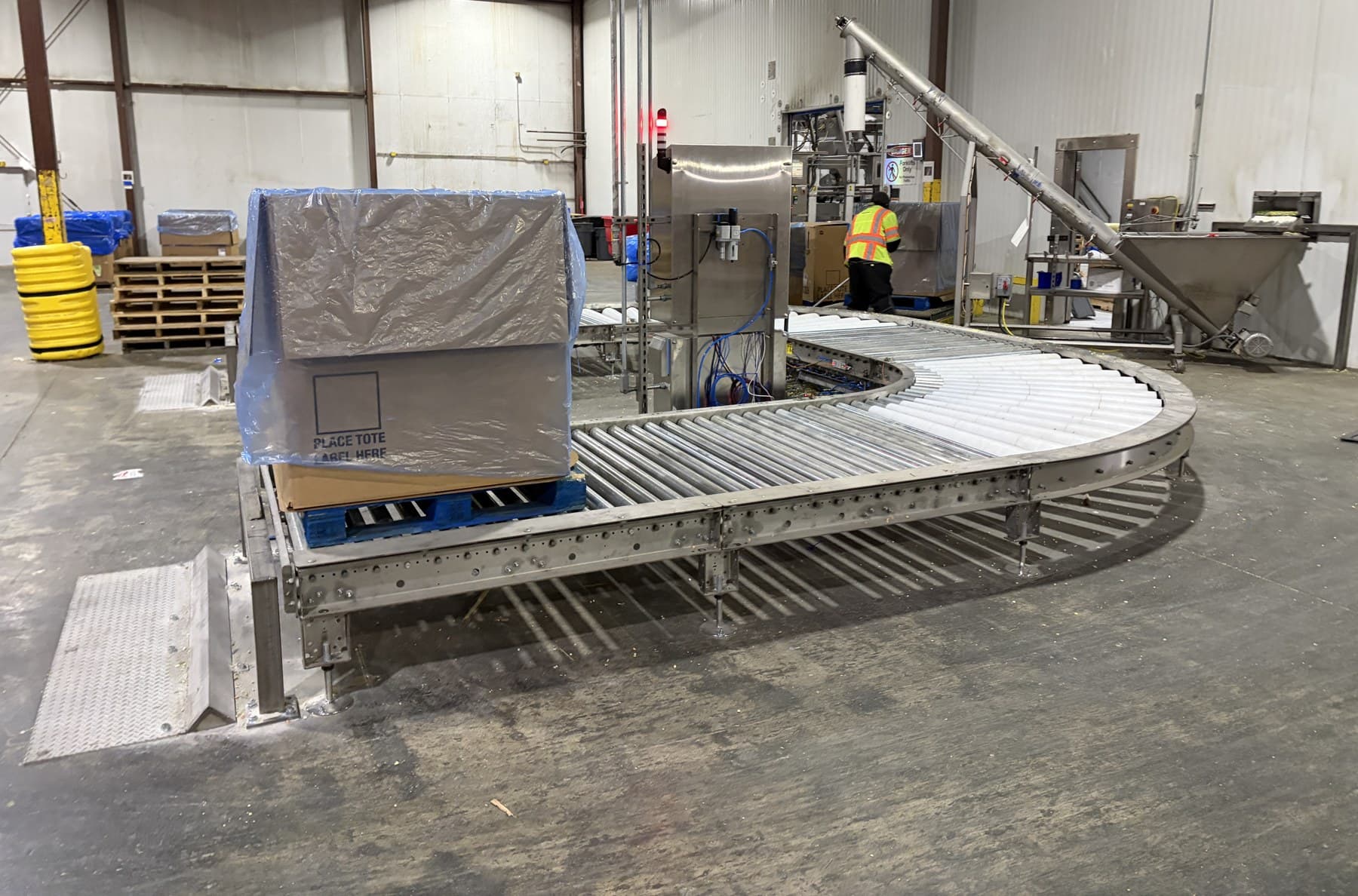
Catalog zones did not fit the robot. A robotic cell wants product presented at a precise pitch, a case stopped exactly where the gripper expects it, and a pallet held square while the load builds. Catalog zone lengths, roller pitches, and sensor positions were built for a generic warehouse and had to be worked around in the cell. AQS now designs the zone, the bed, and the sensing around the application first, which is also why the radius sections on a recent pallet system accept 40-inch and 48-inch pallets with either side leading instead of forcing the plant to orient them.
Washdown found the weak parts. A conveyor rated for washdown on the datasheet still has a drive card, a photo eye, a bearing, and a belt that each have their own rating, and the lowest one wins. AQS now specifies every component on the sanitary path individually, from hygienic feet and sealed bearings to IP67 zone electronics and single-point Meltric power, and designs from the top rating down. Not every conveyor needs IP69K, but every AQS conveyor can be.
The controls were somebody else's. Purchased conveyance came with its own logic, its own interface, and its own idea of how a zone should talk to the system around it. Integrating that into an Allen-Bradley robotic cell meant translating at every boundary. AQS conveyors run on the same CompactLogix and FactoryTalk Optix platform as its VeriPak and IntelliPak products, so a conveyor zone, an inspection result, and a robot handshake live in one program and one record.
Lead times belonged to the catalog. A custom cell on a plant's outage schedule cannot wait for a vendor's production slot. Building conveyance in-house put the layout, the fabrication, and the controls under one roof, which is where AQS's ability to turn layouts and quotes around in the customer's timeframe comes from.
None of these were discoveries AQS was looking for. They were the cost of living with equipment that was almost right, applied over years of cells, and the conveyors that came out of them have been running inside AQS robotic systems ever since.
Why Sell Them Now
AQS's principal engineer ran engineering at a food and beverage robotics integrator for eight years before AQS, designing sanitary conveyance into plants the entire time. When that integrator's robotics group was sold, the plants it had been serving lost a source for the kind of high-control sanitary conveyor systems it built. AQS had been building exactly that for its own cells for years.
At the beginning of 2025, AQS started selling conveyor systems on their own. That is the whole reason it looks new to the conveyor space. The product is not new. The listing is.
The first standalone systems went where the experience was deepest: a stainless 24 VDC pallet circuit for a frozen vegetable processor, a high-speed dairy accumulation line, and a set of sanitary freezer belt conveyors for a snack producer. Each one was a conveyor system first, with no robot attached, and each one was designed the way AQS had been designing conveyance inside its cells all along.
What That Means for Your Line
A buyer does not need to care about AQS's history. The buyer needs to know what changes if AQS does the conveyor instead of the incumbent. Three things do.
The layout is designed for the application instead of the application being fitted to a catalog. The questions AQS asks first are about the product, the room, the sanitation chemistry, the pallet fleet, and the equipment on either end. The conveyor is what falls out of those answers. On a recent project, AQS was the only vendor at the table who understood what actually needed to be quoted, because the quote started from the line rather than from a price list.
Custom layouts and quotes turn around in the customer's timeframe. The people drawing the layout are the people who will build and commission it, and they have been doing this work in food plants for well over a decade.
The conveyor comes with the rest of the platform if you want it, and stands alone if you don't. Allen-Bradley controls, VeriPak integration, IntelliPak feed systems, and robotic palletizing are all the same engineering team and the same controls stack. A conveyor can be the first thing a plant buys from AQS or the last.
About That Vendor Agreement
The story above answers "why AQS." It does not remove a procurement hurdle, and AQS does not pretend it does. If a master equipment agreement or a vendor approval is what stands between a plant and an AQS conveyor, the right move is to ask early what the plant needs from AQS to get one in place, and run that paperwork in parallel with the layouts and quoting.
AQS would rather solve the agreement alongside the engineering than watch a plant swap in a vendor that is starting from zero on the application. The engineering does not pause for the paperwork.
Thinking About Your Line?
If a conveyor layout from AQS has landed on your desk, the fastest way to evaluate it is to ask the questions this paper invites: where is the frame welded, where does the water go, what is the lowest-rated component on the sanitary path, whose controls run it, and who exactly is going to be on the floor at commissioning. Then ask your current vendor the same questions.
AQS engineers and builds sanitary automation for food and beverage processors: conveyance, inspection, palletizing, and the VeriPak Production Quality Platform that ties it together, designed in Nampa, Idaho and supported for life. Tell us about your product, your line, and your sanitation, and we'll tell you what we'd build.
AQS engineers and builds sanitary automation for food and beverage processors, designed in Nampa, Idaho. See the full custom sanitary conveyor line, or the first standalone system in the project spotlight →