Freezer & Arctic Conveyors (−40 °F)
A freezer conveyor (or arctic conveyor) moves product through and out of sub-zero rooms on components rated for sustained operation to −40 °F, with the freezer-to-ambient transition designed so condensation and frost do not stop the belt.
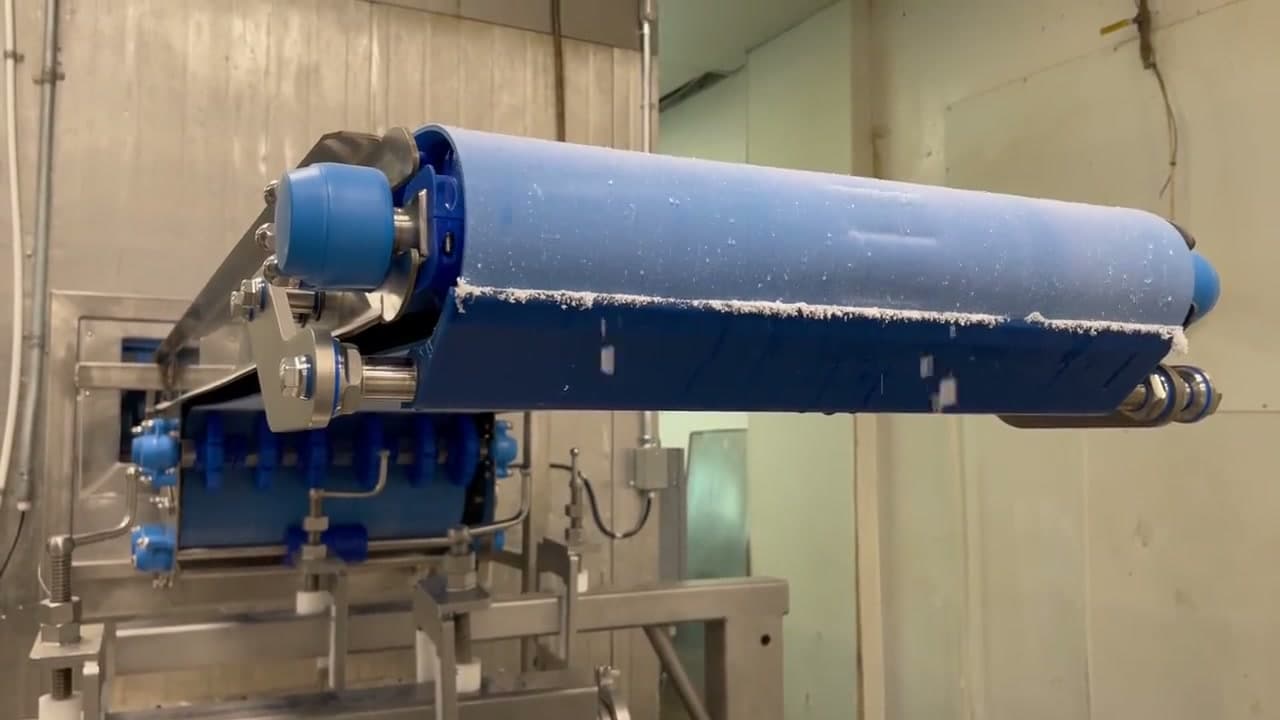
AQS builds freezer conveyors on the same continuous TIG-welded 304 or 316 stainless frames as every other belt conveyor, designed to 3-A Sanitary Standards, then specifies every moving part for the cold: low-temperature lubricants and seals, freezer-rated motors, drive cards, and photo eyes, and belting that stays flexible at −40 °F. Frost builds on a running belt — the marshmallow line pictured above runs frosted every shift — so the frame is open, sloped, and reachable for a quick de-ice and washdown.
The point where product leaves the freezer is where most freezer conveyors fail: warm, wet air meets a cold belt and the frame sweats onto the floor. AQS manages that transition with drainage geometry and, where the room needs it, insulated frame members that keep ice off the drive.
Where a freezer conveyor earns its place
Carry frozen product out of the freezer and into packaging on a belt that is still running cold, with condensation managed where the room changes.
Move racks, trays, or loose product inside the blast freezer on conveyors that live at −40 °F around the clock.
Accumulate cases and pallets in the freezer warehouse before shipping on freezer-rated MDR and pallet conveyors.
Hot product into the tunnel, frozen product out, with belts and cleats chosen for the product at both temperatures.
How AQS builds it
Motors, gearboxes, drive cards, sensors, and belting are specified for sustained sub-zero operation, not derated ambient parts.
Bearings and gearboxes use lubricants that stay fluid in the cold; seals stay pliable so they keep water out through freeze–thaw cycles.
Sloped frames and drainage at the freezer-to-ambient transition, with insulated frame options where sweat and ice would otherwise reach the drive.
Cleated and flat modular belts from Intralox or Habasit chosen for flexibility and grip at temperature, on nosebars that shed ice.
Continuous TIG welds on 304 or 316 stainless, open sides, no closed cavities that can fill with ice — designed to 3-A Sanitary Standards.
The same cold specification carries into 24V MDR and pallet conveyors for staging cases and pallets inside cold storage.
Typical ranges
Every AQS conveyor is engineered to order around the product, the rate, and the room. The ranges below are typical, not limits — tell us what the line needs and we size to it.
| Temperature rating | Sustained operation to −40 °F / −40 °C |
|---|---|
| Configurations | Straight, incline, Z-frame, radius; MDR and pallet conveyors in freezer-rated builds |
| Belt | Freezer-rated flat or cleated modular belt (Intralox, Habasit); FDA-approved materials |
| Frame | 304 or 316 stainless, continuous TIG-welded, sloped for drainage; insulated members optional |
| Protection | IP65 washdown standard; IP69K available |
| Controls | Freezer-rated motors and sensors; Allen-Bradley controls on request |
| Rating | Protects against |
|---|---|
| IP54 | Dust-protected, splash-resistant |
| IP65 | Dust-tight, low-pressure water jets |
| IP66 | Dust-tight, high-pressure water jets |
| IP67 | Dust-tight, temporary immersion |
| IP69K | Dust-tight, high-pressure/high-temp |
Size It Yourself
The free calculators our engineers use to size conveyors — belt pull, speed, throughput, and drive selection. No login; your inputs stay in your browser.
Free belt pull calculator for modular plastic belt conveyors: straight, incline, L, Z, radius and S paths, startup pull, belt check, and drum motor pick.
Free incline conveyor calculator: solve length, rise, and angle for straight, incline, L and Z conveyors, with plain-belt limits and cleat advice.
Free conveyor motor sizing calculator: torque at the sprocket or drum, shaft RPM, hp and kW, standard motor size, and gear ratio from belt pull and speed.
Static and kinetic coefficient of friction table for steel, UHMW, rubber, plastics, aluminum, wood and brass, dry and lubricated.
Common Questions
Tell us about your line
Send us the product, the rate, the room it runs in, and how it gets washed down. An AQS engineer comes back with a layout sketch and a budgetary range — no catalog, no sales script.
Tell Us About Your Line →