Sanitary Incline & Decline Conveyors
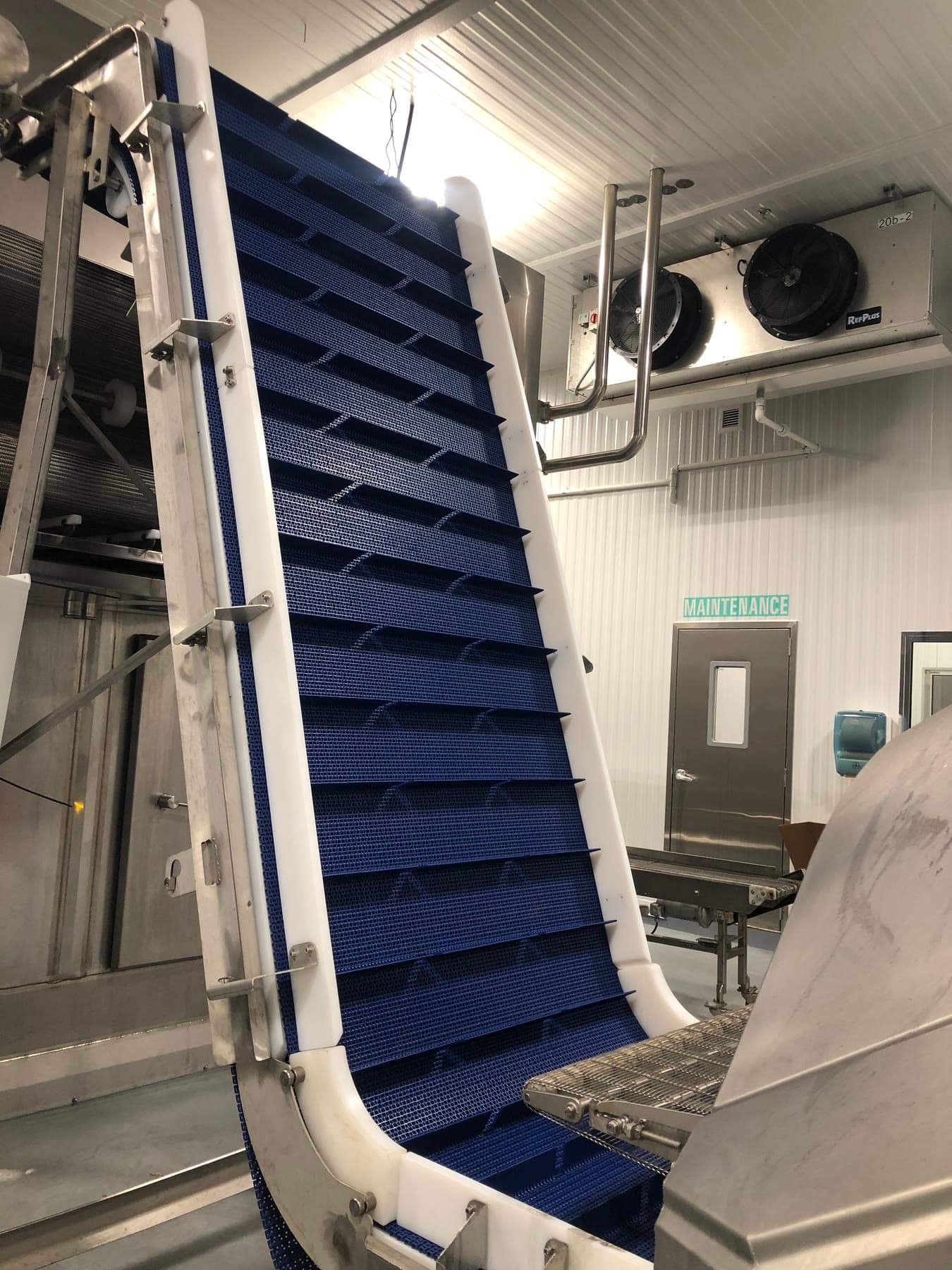
An incline conveyor (or decline conveyor, running the other way) moves product between elevations on a cleated, textured, or sidewall belt, with a nosebar or Z-frame transition so product is not dropped at either end.
AQS builds inclines as straight ramps, L-frames with a horizontal infeed, and Z-frames with horizontal infeed and discharge, on continuous TIG-welded 304 or 316 stainless frames designed to 3-A Sanitary Standards. Cleated and sidewall modular belts from Intralox or Habasit carry packaged product and loose bulk product up angles a plain belt cannot hold, and the frame is sloped so washdown water runs off instead of following the belt.
The angle, the cleat height and pitch, and the belt pull through the transitions are the numbers that decide whether the conveyor works. The incline calculator below solves the geometry from the rise and the floor space available; the belt pull calculator sizes the drive.
Where an incline conveyor earns its place
Lift product from a floor-level packer to an elevated inspection, casing, or palletizing level in the footprint of a ramp.
Carry product into and out of spiral and tunnel freezers on a freezer-rated belt with condensation managed at the transition.
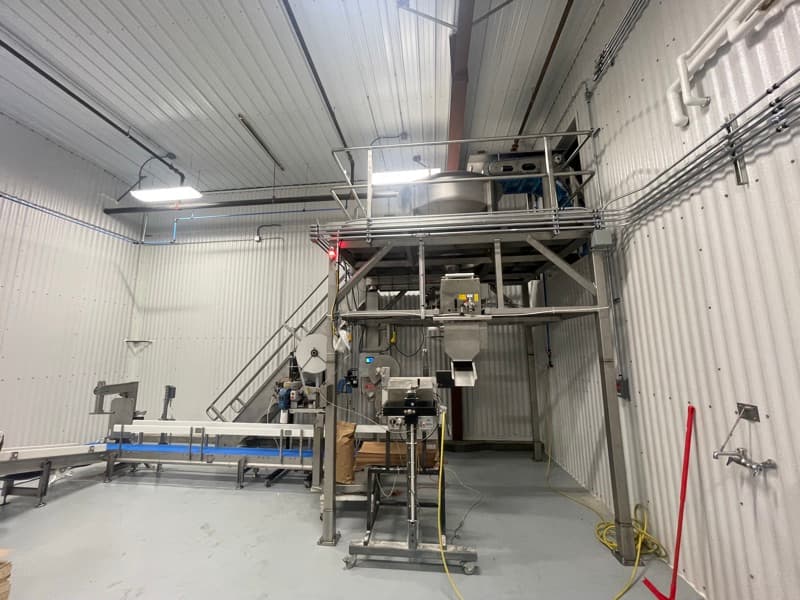
Sidewall belts with cleats lift loose product — pieces, granules, frozen product — into hoppers, baggers, and weighers.
Feed a vertical form-fill-seal or a case packer whose infeed sits above the line, with a horizontal discharge that meters product in.
How AQS builds it
Cleat height and pitch are chosen for the product's size and the angle; corrugated sidewalls keep loose product on the belt at steep angles. All belting is FDA-approved.
A Z-frame keeps the infeed and discharge horizontal so product loads and unloads flat; a straight incline or L-frame is shorter where the ends can be angled.
Small-diameter nosebars at the transitions let small product transfer without falling into a gap, on both the infeed and the discharge.
Continuous TIG welds on 304 or 316 stainless with sloped members and open sides, so the frame drains and the underside of the belt can be reached for cleaning.
Return-side hold-downs keep a cleated belt tracking through the bends of a Z-frame; sanitary guide rails keep product centred on the incline.
Freezer builds use low-temperature seals and lubricants and manage condensation where the belt crosses from freezer to ambient, rated to −40 °F.

Typical ranges
Every AQS conveyor is engineered to order around the product, the rate, and the room. The ranges below are typical, not limits — tell us what the line needs and we size to it.
| Configurations | Straight incline, L-frame, Z-frame, decline |
|---|---|
| Belt | Cleated or sidewall modular belt (Intralox, Habasit); FDA-approved materials |
| Frame | 304 or 316 stainless, continuous TIG-welded, sloped for drainage, mirror polish |
| Temperature | Ambient; freezer-rated build to −40 °F available |
| Protection | IP65 washdown standard; IP69K available |
| Controls | Gear motor with VFD; Allen-Bradley controls on request |
| Rating | Protects against |
|---|---|
| IP54 | Dust-protected, splash-resistant |
| IP65 | Dust-tight, low-pressure water jets |
| IP66 | Dust-tight, high-pressure water jets |
| IP67 | Dust-tight, temporary immersion |
| IP69K | Dust-tight, high-pressure/high-temp |
Size It Yourself
The free calculators our engineers use to size conveyors — belt pull, speed, throughput, and drive selection. No login; your inputs stay in your browser.
Free incline conveyor calculator: solve length, rise, and angle for straight, incline, L and Z conveyors, with plain-belt limits and cleat advice.
Free belt pull calculator for modular plastic belt conveyors: straight, incline, L, Z, radius and S paths, startup pull, belt check, and drum motor pick.
Free conveyor motor sizing calculator: torque at the sprocket or drum, shaft RPM, hp and kW, standard motor size, and gear ratio from belt pull and speed.
Free conveyor throughput calculator: lb/hr, lb/day or kg/hr to packages per minute, belt speed, and belt load in lb/ft, plus bulk bed sizing.
Common Questions
Tell us about your line
Send us the product, the rate, the room it runs in, and how it gets washed down. An AQS engineer comes back with a layout sketch and a budgetary range — no catalog, no sales script.
Tell Us About Your Line →