Zero-Pressure Accumulation Conveyors
An accumulation conveyor (zero-pressure accumulation, or ZPA conveyor) buffers product between two machines that do not run at the same speed, holding cases, trays, or pallets in a queue without letting them push on each other.
AQS builds accumulation as 24V MDR zones for cases and pallets — each zone stops its own roller when the zone ahead is full — and as belt or modular-belt accumulation for trays and packages that need a continuous surface. Both run on continuous TIG-welded stainless frames designed to 3-A Sanitary Standards, with washdown-rated PulseRoller options and IP67 drive cards where the room is hosed down.
The buffer is sized in seconds of downstream stoppage at the incoming rate, then turned into feet of conveyor at the product's closed-up pitch. The accumulation calculator below does that arithmetic; the line flow simulator shows what the whole line does when a downstream machine stops.

Where an accumulation conveyor earns its place
Hold cases through a jam clear or a pallet change so the upstream line never stops.
Absorb the difference between a fast filler and a slower labeler, or between two shifts' rates.
Give sanitation and changeover crews minutes of runway without shutting down production upstream.
Accumulate loaded pallets ahead of a stretch wrapper or forklift pickup so the fill station never waits.
How AQS builds it
Each 24V MDR zone has its own roller, sensor, and drive card; zones talk to their neighbours for singulation or slug release with no PLC code.
A zone stops when the one ahead is occupied, so product queues with a gap and nothing is crushed at the head of the line.
Where product needs a continuous surface, low-friction modular belt accumulates against a stop with the belt slipping under the product.
Buffer time × rate × closed-up pitch = feet of conveyor. AQS sizes it from your worst-case downstream stop, not a catalog length.
Continuous TIG-welded stainless frames, PulseRoller washdown rollers, IP67 drive cards, sealed sensors — designed to 3-A Sanitary Standards.
Release logic ties into the downstream machine's ready signal; zone status can report to VeriPak SCADA on Allen-Bradley controls.
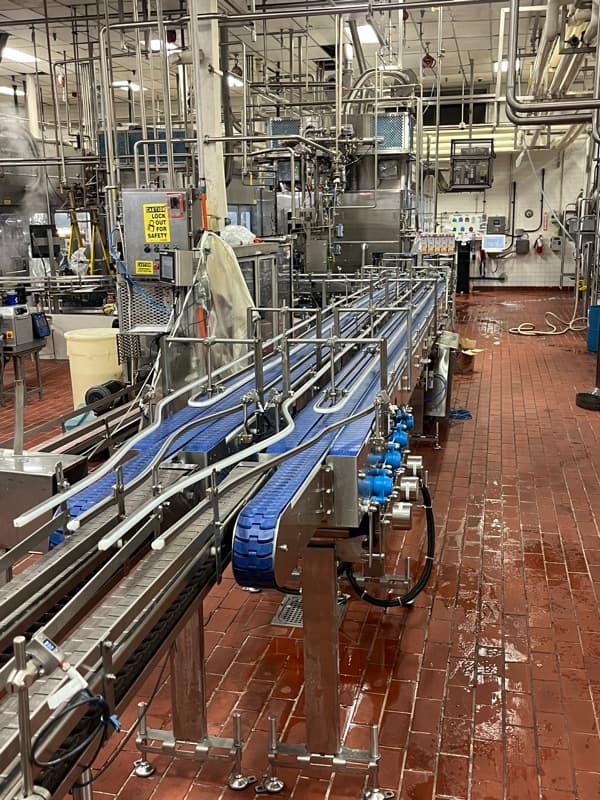
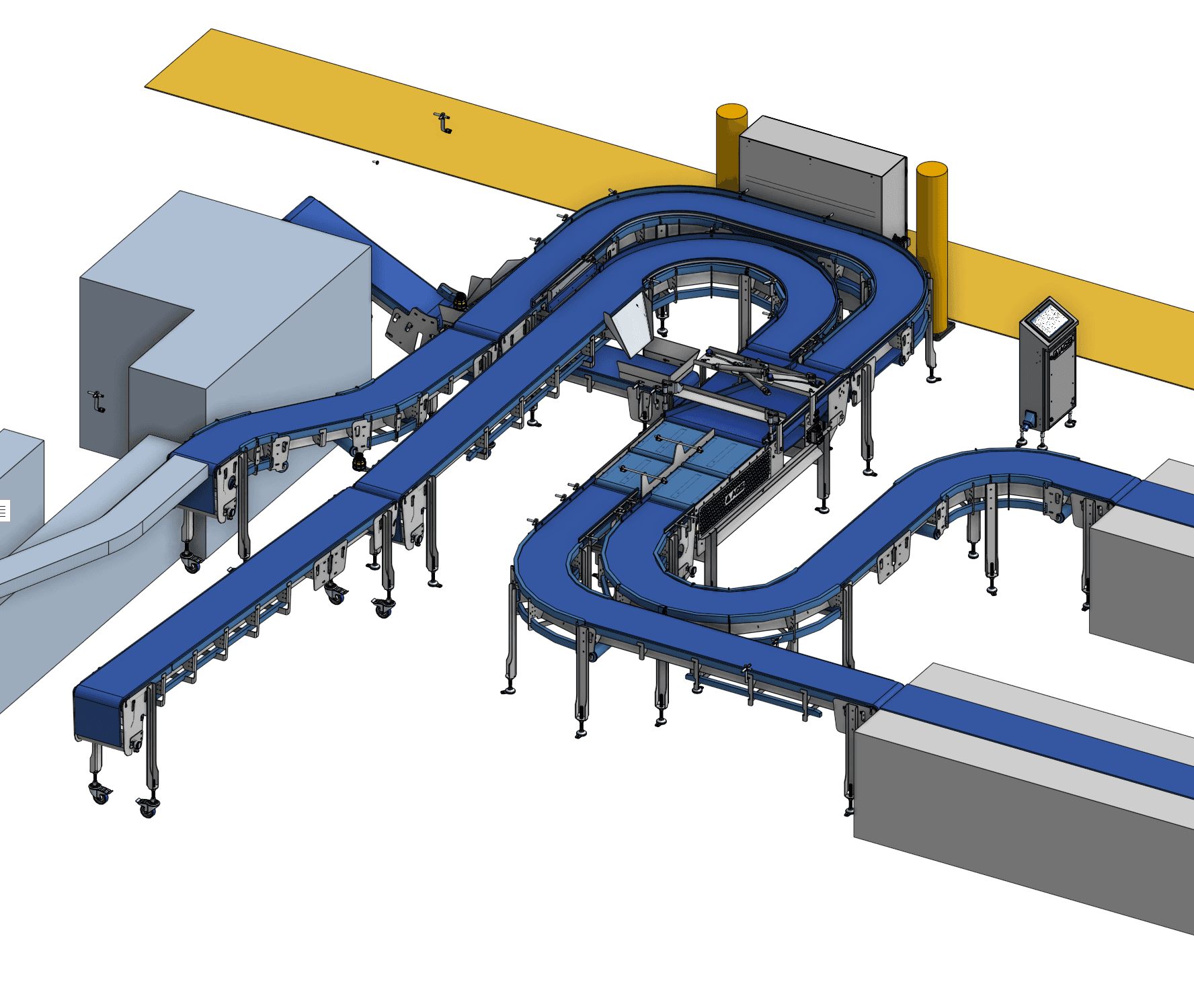 Engineering render
Typical ranges
Every AQS conveyor is engineered to order around the product, the rate, and the room. The ranges below are typical, not limits — tell us what the line needs and we size to it.
| Types | 24V MDR zone accumulation (cases, pallets); modular belt accumulation (trays, packages) |
|---|---|
| Release modes | Singulated (one per zone) or slug (train release), selectable per zone |
| Buffer capacity | Sized in seconds of stoppage at the incoming rate — see the accumulation calculator |
| Frame | 304 stainless, continuous TIG-welded, sloped for drainage |
| Temperature | Ambient; freezer-rated components available |
| Protection | IP65 washdown standard; IP67 drive cards; IP69K-capable frames |
| Controls | Zone logic in the drive cards; Allen-Bradley CompactLogix ready; VeriPak reporting on request |
| Rating | Protects against |
|---|---|
| IP54 | Dust-protected, splash-resistant |
| IP65 | Dust-tight, low-pressure water jets |
| IP66 | Dust-tight, high-pressure water jets |
| IP67 | Dust-tight, temporary immersion |
| IP69K | Dust-tight, high-pressure/high-temp |
Size It Yourself
The free calculators our engineers use to size conveyors — belt pull, speed, throughput, and drive selection. No login; your inputs stay in your browser.
Free accumulation conveyor calculator: buffer length in feet for seconds of stoppage, or the time a length absorbs, with zero-pressure zone counts.
Free packaging line flow simulator: chain splits, merges, rejects, dwell stations, stacking and batching, and size accumulation buffers in feet or seconds.
Free MDR motorized drive roller selection chart: torque, belt pull and RPM per OneMotion series at your roller length, and the smallest series that fits.
Free conveyor speed calculator: belt speed in ft/min from packages per minute, product length and gap, or solve for rate or gap. Gap time and transit time.
Common Questions
Tell us about your line
Send us the product, the rate, the room it runs in, and how it gets washed down. An AQS engineer comes back with a layout sketch and a budgetary range — no catalog, no sales script.
Tell Us About Your Line →